How Often Should You Change Your Whole House Water Filter?
Learn the recommended replacement schedule for whole house water filters, signs your filter needs changing, and how Utah water affects filter life.
Noah Hoggan
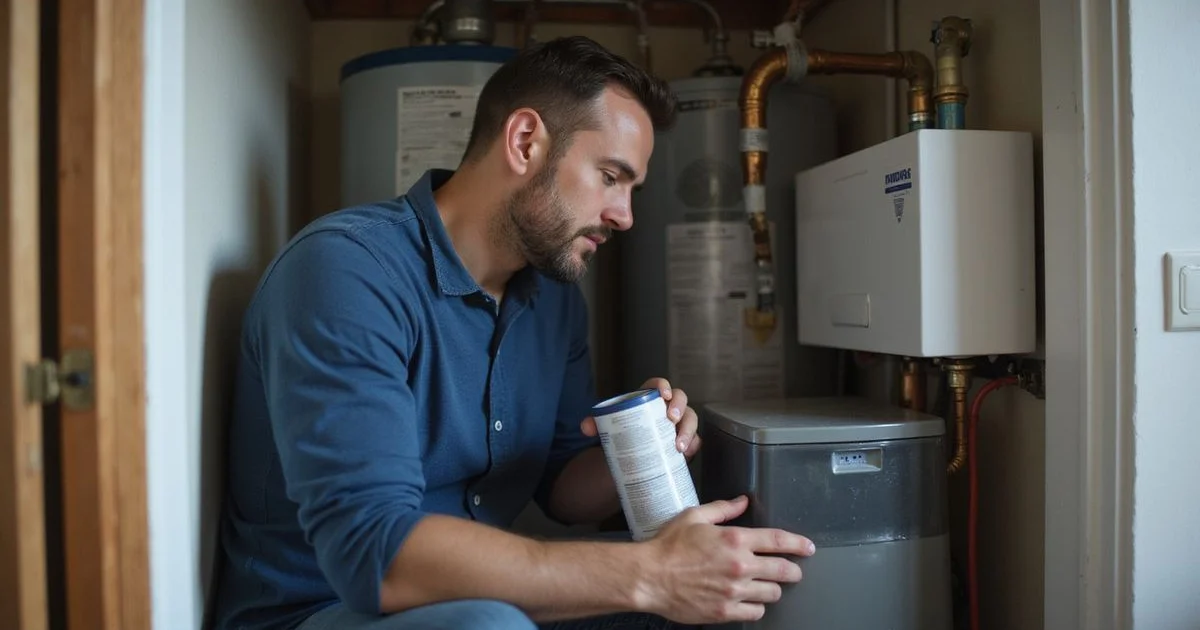
Your whole house water filter works hard every day to treat every gallon that flows into your home. We often see homeowners install these systems and assume they are maintenance-free solutions.
Real-world performance data tells a different story.
Filtration media eventually becomes saturated with the contaminants it captures. This saturation causes the filter’s effectiveness to decline rapidly. If you’re still choosing a system, our guide on the best whole house water filter for Utah hard water covers what to look for.
We have found that replacing your filter before water quality suffers is the single most important factor in protecting your home’s plumbing.
Here is a practical guide to filter replacement schedules, the specific warning signs to watch for, and how our local water conditions affect longevity.
General Replacement Guidelines
Filter replacement frequency depends heavily on the type of media, your household water usage, and the specific chemistry of your incoming water supply. Most manufacturers provide a baseline based on average national water quality.
We have adjusted these standard benchmarks to reflect the reality of high-usage households:
| Filter Type | Standard Replacement Interval | Heavy Use / Hard Water Interval |
|---|---|---|
| Sediment Pre-filter (5-micron) | Every 3-6 months | Every 2-3 months |
| Carbon Block Filter | Every 6-12 months | Every 4-6 months |
| Granular Activated Carbon (GAC) | Every 6-12 months | Every 6-9 months |
| KDF 55/85 Media | Every 12-24 months | Every 12-18 months |
| Multi-Stage Media Tank | Every 5-10 years | Every 3-5 years |
Important: These are general guidelines. Your actual replacement schedule may need to be much shorter depending on your daily gallon usage.
How Local Water Conditions Affect Filter Life
If you live in Salt Lake County, your filter is facing a much tougher challenge than the national average. We consistently measure water hardness levels that exceed typical municipal standards.
This heavy mineral load significantly accelerates the degradation of filtration media.
Higher Mineral Content
Water in our region frequently tests between 15 and 25 grains per gallon (gpg) of hardness. These dissolved minerals, primarily calcium and magnesium, pass through your filter constantly.
We know that while standard carbon filters aren’t designed to soften water, the physical presence of these minerals can coat the media.
This “fouling” process prevents the carbon pores from absorbing chemicals effectively. A study by the Water Quality Association suggests that extreme hardness can reduce the efficiency of water treatment appliances by up to 30%.
Chlorine and Chloramine Levels
Many municipalities now use chloramines (a mix of chlorine and ammonia) for disinfection because they remain stable longer in the pipes. Our testing shows that chloramines are more difficult to remove than standard chlorine.
Catalytic carbon is required to effectively break down chloramines, but it has a finite lifespan. Once the catalytic sites on the carbon are full, chemicals will pass right through to your tap.
Seasonal Sediment Variation
Spring runoff creates a unique challenge for homeowners in the Mountain West. We see a significant spike in turbidity (cloudiness) and suspended solids during snowmelt and after heavy rainstorms.
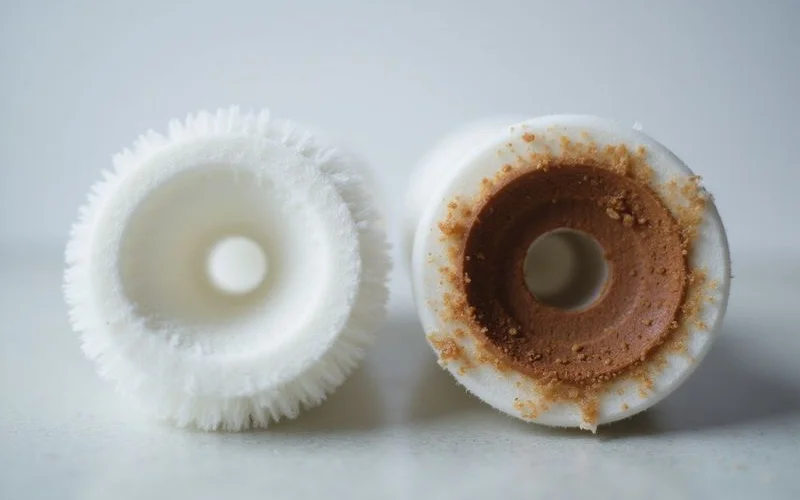
Your sediment pre-filter acts as the first line of defense during these events. It is common for a standard white pre-filter to turn dark brown or black in just a few weeks during the spring season.
5 Signs Your Filter Needs Replacing
You should not wait for your water to taste bad before checking your system. We train our technicians to look for early indicators that appear before water quality creates a health concern.
1. Reduced Water Pressure
A clogged filter physically blocks the path of water. We recommend checking your pressure gauge; a drop of 10-15 PSI (pounds per square inch) is a clear signal that the sediment filter is saturated.
Flow restrictions will happen gradually. You might notice that two showers cannot run simultaneously, or the washing machine takes longer to fill.
2. Change in Taste or Odor
Carbon media eventually reaches a “breakthrough” point where it can no longer adsorb contaminants. We often hear customers complain about a return of that swimming-pool chlorine smell.
This olfactory change is usually the first sensory warning that the carbon bed is exhausted.
3. Visible Discoloration
Water should always be crystal clear. We advise you to fill a clear glass and hold it up against a white background to check for tint.
A yellow or brown tint suggests that tannins or oxidized iron are bypassing the filter.
4. Increased TDS Readings
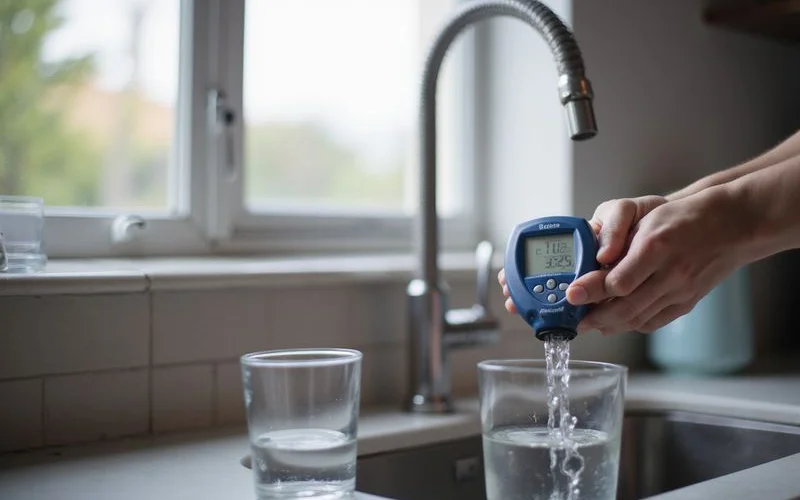
Testing your water with a digital meter provides an objective data point. We use HM Digital TDS (Total Dissolved Solids) meters to track performance over time.
A sudden jump in TDS often means the media has degraded or channels have formed within the tank, allowing water to slip through untreated.
5. Time Since Last Replacement
Filter media breaks down physically over time, even if you haven’t used your full gallon capacity. We warn homeowners that bacteria can colonize inside a wet filter that sits too long without a change.
Organic material trapped in the filter becomes a food source for bacteria after 6 to 12 months.
Setting Up a Maintenance Schedule
Reliable water quality requires a proactive approach rather than a reactive one. We suggest moving away from “guessing” and using a gallon-tracking method if possible.
Smart water monitors, like those from Moen or Phyn, can track exactly how much water flows through your main line.
If you do not have a smart monitor, follow this simple calendar-based protocol:
- Mark the installation date clearly on the filter housing using a permanent marker.
- Set a recurring digital reminder on your phone for 75% of the manufacturer’s rated lifespan.
- Keep a spare filter on hand so you are never tempted to stretch the life of a dirty filter.
- Log your filter changes in a notebook or app to track if replacement intervals are getting shorter.
For large tank systems, we recommend an annual checkup to ensure the control valve is counting gallons correctly and backwashing on schedule.
Can You Replace Filters Yourself?
Simple cartridge-style filters, such as 4.5-inch “Big Blue” sediment or carbon block filters, are generally user-friendly. We encourage homeowners to handle these changes to save on service costs.
You will need a filter wrench, a bucket for spills, and food-grade silicone lubricant for the O-ring.
However, multi-stage tank systems and media re-bedding are complex tasks best left to professionals.
We have seen DIY attempts result in damaged distributor tubes or resin escaping into the home’s plumbing.
Professional re-bedding involves:
- Vacuum extraction of hundreds of pounds of heavy, saturated media.
- Sanitization of the tank to prevent bacterial growth.
- Gravel under-bedding placement to ensure proper flow rates.
- Valve reprogramming to match the new media specifications.
How We Help Our Customers
Water & Wellness West Valley does more than just sell equipment. Our team focuses on long-term water management for your home.
We include a comprehensive maintenance plan with our installations to remove the guesswork. For customers who prefer a zero-maintenance option, our in-store water refill station provides premium filtered water with no equipment to maintain.
- Free in-home water testing allows us to build a baseline for your specific water chemistry.
- Automated reminders ensure you never miss a critical service interval.
- Professional maintenance service is performed by our Master Plumber and trained technicians.
- Transparent pricing guarantees you know the cost of replacement filters upfront.
We have been maintaining whole house filtration systems for Salt Lake County families for over 20 years. Our technicians understand the specific challenges of Utah water better than any national call center ever could.
Get Your Water Tested
Uncertainty about your filter’s condition can be resolved with a simple test. We can measure your current water quality, compare it to your raw supply, and determine exactly how much life is left in your media.
Schedule your free water test or call us at (801) 967-9669.
The process takes about 30 minutes. You will get clear answers without any obligation.
About Noah Hoggan
20+ Years Experience | BBB A+ Rated | Master Plumber on Staff
Noah Hoggan has been helping Utah families improve their water quality for over 20 years. As the owner of Water & Wellness West Valley and a BBB A+ rated business, he brings hands-on expertise in water filtration, softening, and purification systems tailored to Salt Lake County's unique water conditions.
Get Your Free Water Test
Wondering about your home's water quality? Our experts will test your water and provide honest recommendations — no pressure, no obligation.